The Amarnath Yatra: A Journey into Spiritual Significance
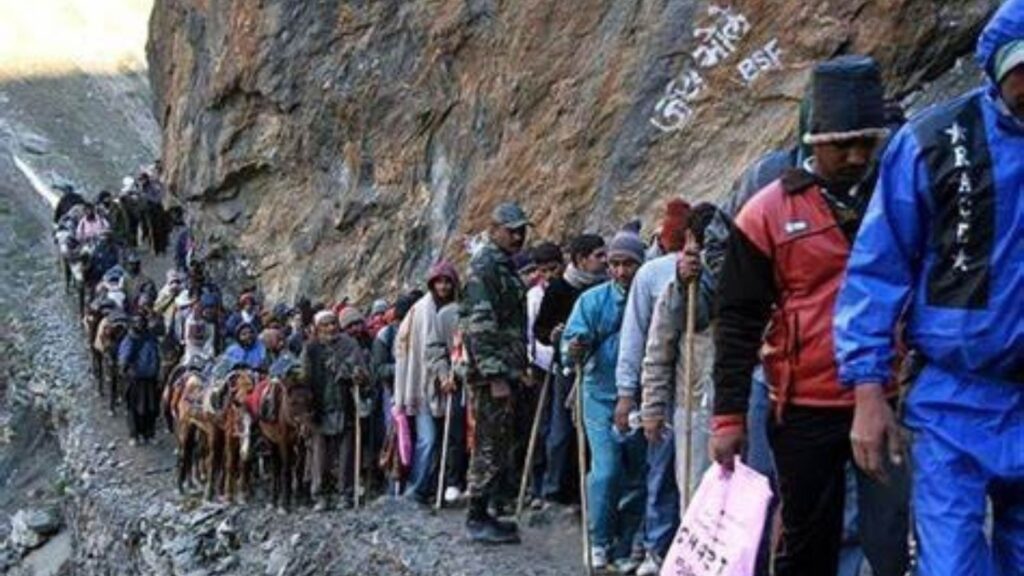
The Amarnath Yatra holds deep spiritual significance for millions of Hindu devotees. This annual pilgrimage, managed by the Shri Amarnathji Shrine Board, draws thousands of pilgrims to embark on a transformative journey from July to August. Darshan at the Holy Cave starts from 6:00 AM to 4:00 PM. Pilgrims can choose between the 47 km Pahalgam route and the shorter but steeper 14 km Baltal route. Climbing to the Amarnath Cave, situated at 13,000 feet above sea level (ASL), is quite a challenge, requiring physical preparedness
and acclimatization.
The Amarnath Yatra is a testament to the essence of unity, as evident from the legend of the Muslim shepherd Buta Malik. It is said that when Buta Malik was gifted a bag of coal by a sadhu, who was actually Lord Shiva in disguise, he found it filled with gold upon reaching home. His subsequent search for the sadhu led him to discover the Amarnath Cave. Even today, the predominantly Muslim porters, doli carriers, and volunteers at the langars support the pilgrimage, showing the years of amalgamation and harmony that this religious site has fostered.
Origin and History
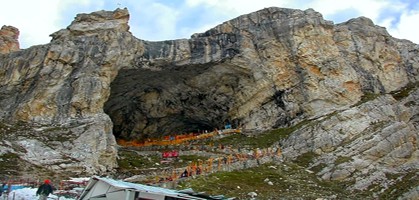
According to Hindu mythology, the Amarnath Cave is believed to be the sacred site where Lord Shiva revealed the secrets of immortality to his beloved consort Goddess Parvati. This celestial discourse, known as the amar katha, is said to have taken place within the icy confines of this hallowed cave which is about 130 feet tall, and is situated at 12,756 feet ASL.

Legend further says that at one point, as Goddess Parvati slept, a pair of pigeons, who happened to overhear the divine exchange, were blessed with immortality. Even today, despite the challenging conditions of high altitude and frigid temperatures, pilgrims may catch a glimpse of these celestial companions within the cave.
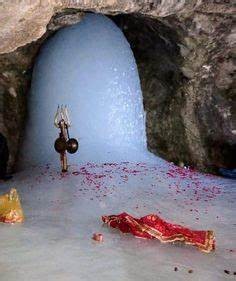 At the heart of this revered pilgrimage site stands an awe-inspiring ice stalagmite in the form of a lingam, taken by many as a sign of the mystical powers that are said to pervade the Amarnath Cave. This sacred formation waxes and wanes with the phases of the moon, enhancing the profound spiritual aura that envelops the Amarnath Yatra.
Significance of the Yatra
The significance of the Amarnath Yatra lies in its spiritual essence and the belief that a pilgrimage to the cave grants absolution from the cycle of birth and death, or moksha. For many Hindus, the Amarnath Cave is a place where the divine presence of Lord Shiva is believed to be tangible. 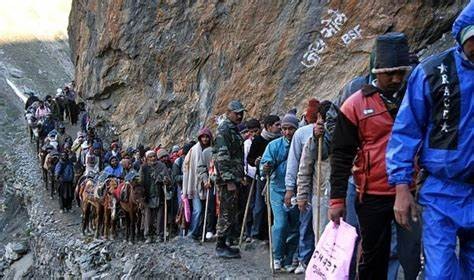 The ice lingam that forms naturally inside the cave is seen as a symbol of Lord Shiva’s cosmic powers and immortality. It is believed that a mere glimpse of this sacred formation can wash away sins and grant eternal happiness as it is one of the 51 Shakti Peethas, offering pilgrims a chance for spiritual purification and the fulfillment of their deepest desires. Thousands brave the challenging high-altitude trek each year, driven by an unshakable faith and the lure of the divine. For them, the Amarnath Yatra transcends the physical realm, becoming a transformative journey that connects the mortal with the immortal, the finite with the infinite.
Registration Process
There are some eligibility criteria in place for people wishing to take the pilgrimage to Amarnath. People aged below 13 or above 70 years, as well as pregnant women beyond six weeks, are ineligible for registration. Registration is done through an online process with a fee of INR 150 per person. Prospective Yatris must submit a clear, color scan of a valid Compulsory Health Certificate (CHC) issued by an authorized doctor, accompanied by a recent passport-sized photograph.
Upon registration, Yatris must undergo biometric e-KYC authentication and obtain an RFID card from designated centres across Jammu & Kashmir before commencing the Yatra. Access beyond the Domail/Chandanwari access control gate is restricted exclusively to individuals with a valid RFID card.
Route & Journey
The traditional route starts from Pahalgam, and pilgrims trek through rugged terrain, passing through Chandanwari at 9,500 feet ASL, Sheshnag at 11,730 feet ASL, and Panchtarni at 12,000 feet ASL before reaching the holy Amarnath Cave at 12,756 feet ASL. This trek is a 47 km journey, typically taking 3-5 days one way, depending on the pilgrims’ pace. Helicopter facilities from the base camp to Panchtarni, 6 km from the cave, are also available. This route is wide and features gradual slopes compared to the Baltal trek. It is recommended for the elderly, sick, or those with a history of illnesses, due to its more manageable terrain and wider paths.
The shorter Baltal route to Amarnath Cave is a 14 km trek, offering a round trip feasible within 1-2 days. This route, via Domial, Barari, and Sangam, is challenging due to steep slopes, making it unsuitable for ponies, for safety reasons. Travelers must either walk or be carried on a doli (a seat carried atop shoulders). It is preferred for return journeys from the shrine due to potential health risks from steep heights for those not acclimatized to high altitudes.
Accommodation & Food
Along both the Baltal and Pahalgam routes, private tents have been erected at various points, which offer comfortable accommodation with amenities like quilts, mattresses, blankets, and pillows, priced between INR 250-1000 per night.
Yatris are provided with complimentary food, water, and refreshments throughout the journey, with langars set up at multiple locations. These langars, despite the harsh terrain, are free of cost, and the people running them welcome you with open arms, treating you as an honored guest. Essential ration supplies for cooking are also available at fair prices from government depots along the way. There are also various tea stalls and small restaurants dotting the routes.
Clothing and Gear Must-Haves
Since the Yatra is conducted during the monsoon, it is advisable to carry a raincoat/poncho, quick-dry pants and tops, a windcheater, rain-proof jackets designed for around 10-degree weather, sunglasses, waterproof mid-to-high ankle trekking shoes, a hiking pole, a torch, a woolen cap, and gloves.
Written by Vallari Parashar